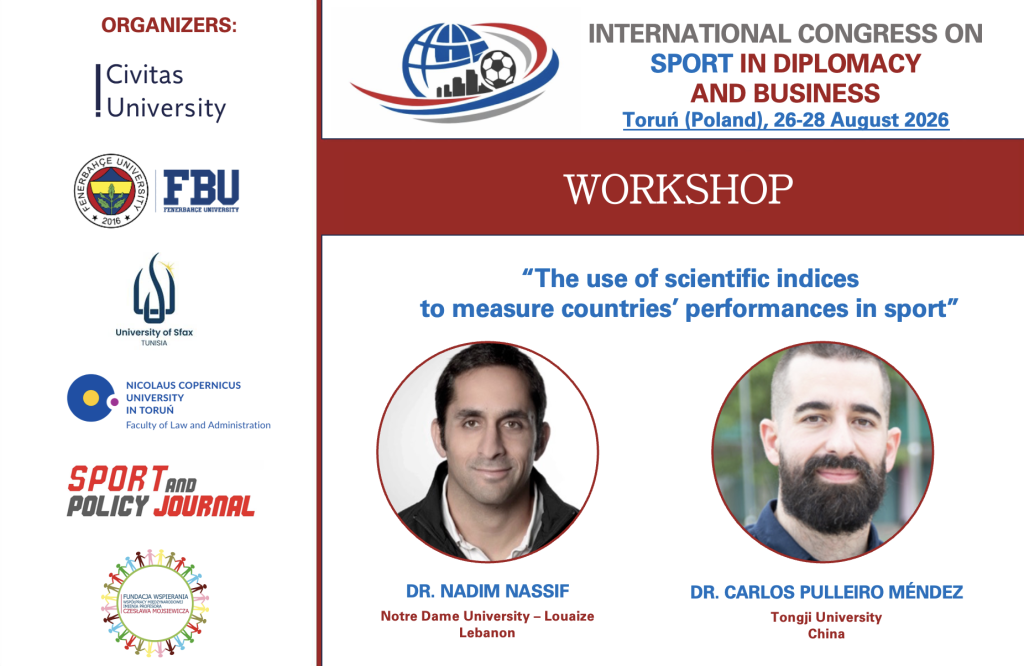
The use of scientific indices to measure countries’ performances in sport

Nadim Nassif is an Associate Professor in the Department of Psychology, Education, and Physical Education at the Faculty of Humanities in Notre Dame University – Louaize (NDU), Lebanon. He is the chair of the International Center for Sport Policy & Governance (ICSPG), a think tank based in NDU. He is the academic advisor of the physical education and sports major and former manager of the NDU FIFA/CIES Sports Management Program.
He has a BA in Physical Education, a FIFA Master in Sport Management, an MPhil in Sport History, and a PhD in Sport Sociology. His research interests encompass sport history, coaching, and sport management, mainly in the field of sport governance. He is the founder of the scientific platform World Sports Rankings (WSR), which promotes the rankings (WRCES, WRCES Merit Ranking, WSPI, and WFCR) developed by the ICSPG.
He is an international coach in both futsal and MMA. He is a futsal instructor for the Asian Football Confederation (AFC) and a consultant for the International Mixed Martial Arts Federation (IMMAF).

Carlos Pulleiro Méndez (Bilbao, 1987) obtained in 2016 his PhD in International Studies at the University of the Basque Country (Spain). Between 2018 and 2021 he was a research fellow at the European Research Centre of the Sun Yat-sen University. In 2019 and 2020 he was a visiting scholar at the Leisure Studies Centre of the University of Deusto, in Spain. In 2022 he continues in Spain being a lecturer in the Physical Activity and Sport Sciences Degree of the European University of Gasteiz (EUNEIZ). Currently he is an associate researcher at the International College of Football of the Tongji University in China. His main research line is sports diplomacy.
About the workshop:
Many studies look at sport development in isolation, without considering the broader global political context in which countries operate. At the same time, the national power of countries is rarely understood as a key factor to understand the results of international sports competitions. Accordingly, we will explore the connection between the international geostructure of power and elite sport development.
We will first examine the composition of different international sports scientific rankings. We will start with the World Ranking of Countries in Elite Sport (WRCES), which measures all the national teams’ performances in all the recognized sports, Olympics and non-Olympics. The WRCES will allow us to identify the factors that lead to countries’ success in elite sport, which will lead us to understand the WRCES Merit Ranking, which measures national teams’ performances relatively to their economic capacities. We will then explore the World’s Fittest Countries Ranking (WFCR), which measures the level of fitness of countries’ populations, and the World Sport Power Index (WSPI), which by considering national teams’ performances, hosting of major sports events, and global visibility of the local professional sports leagues, measures countries’ capacities to leverage sport as a tool to enhance their soft power. In the final part, we will examine the World Power Index (WPI), a geopolitical ranking that offers a comprehensive and relational understanding of national power from an International Relations perspective, and its relationship with the WRCES and WSPI. The very strong correlation between the WPI, WRCES, and WSPI, first shows that the WRCES and WSPI provide a more comprehensive analysis of elite sport development and performance than the Olympic medal table. It also demonstrates that sport, because of its capacity to contribute to international prestige of countries, is a unique revealer of national power and producer of soft power.